
Review – Bernarda Fink sings Mahler Lieder
Bernarda Fink sings Mahler Lieder
Bernarda Fink mezzo-soprano
Anthony Spiri piano
Gustav Mahler-Ensemble
Tonkünstler-Orchester Niederösterreich
Andrés Orozoco-Estrada
Harmonia Mundi HMC 902173

Though born in Argentina, Bernarda Fink is of Slovenian extraction and her husband (a diplomat rather than another musician) is Austrian, so perhaps one can infer a special spiritual connection with Mahler: after all, the composer famously took time away from the stresses and politicking of Vienna at his house on the Wörthersee in Carinthia, the region of Austria that borders Slovenia.
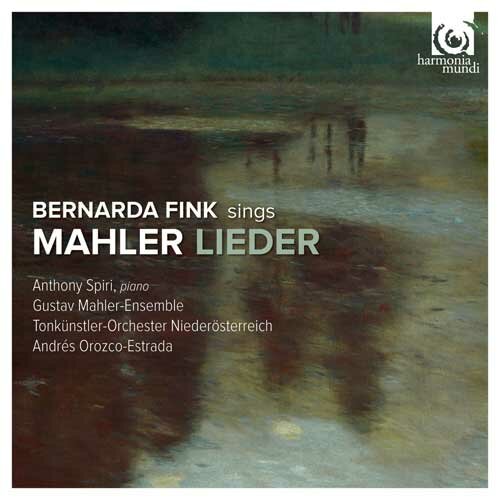
The idea for this album came from Fink herself. Conceived to trace Mahler’s progress as a composer of songs, and to highlight their relationship to his symphonies, it offers repertoire ranging from rarely-heard early songs – such as the exuberant Im Lenz of 1880, written to Mahler’s own text – to the mature cycles. Before recording it, Fink gave a series of concerts with the other musicians who appear on the disc, and her voice is presented in a variety of settings: with piano (her partner is Anthony Spiri), with a chamber ensemble (in the Lieder eines fahrenden Gesellen, arranged by Schoenberg in 1920, two years before he made his hauntingly stark chamber version of the marvellous Song of the Wood Dove from Gurrelieder), and with orchestra. All five songs of Kindertotenlieder are duly accompanied by the Tonkünstler-Orchester Niederösterreich under Andrés Orozoco-Estrada, but the four songs from Rückert-Lieder – the cycle’s lightest-hearted component, ‘Blicke mir nicht in die Lieder!’ is omitted for some reason – are presented in a hybrid format: two with orchestra and two with piano; one of the latter, rather surprisingly, is ‘Um Mitternacht’, which surely makes a stronger impact with a triumphant brass choral at its climax.
Fink is not the kind of interpreter who emphasises the neurosis, fatalism and even grotesquerie that can be found in Mahler. She is essentially a well-mannered singer who respects the music and the text and does not impose her will upon it in an arbitrary or point-making fashion. Nor does she have a voice that sears itself into the brain: it is a warm, unforced and appealing lyric mezzo, perhaps less honeyed today than it was five or so years ago, which suggests a sympathetic presence in an intimate environment rather than a Wagnerian diva in a grand hall. Though it is hard to fault her – especially when thinking of some singers’ contrivances in Mahler – she could tug the heart strings more strongly at certain key moments. A case in point occurs in the single selection from Des Knaben Wunderhorn, ‘Wo die schönen Trompeten blasen’, when the girl says to her (dead?) lover: “Willkommen, lieber Knabe mein, so lang hast du gestanden!” (Welcome my dearest lad, you have waited so long!). Fink is by no means inexpressive, but she does not quite achieve a potent fusion of heartache, longing and love.
Her relatively discreet approach is echoed by the other performers on the disc: the accompaniments are not weighed down by dragging tempi or appliqué expressivity. Recorded in natural-sounding acoustics in Berlin and Grafenegg, near Vienna, this disc makes a refreshing antidote to the excesses to which performances of Mahler have sometimes become prone.
About Yehuda Shapiro
